Getting a member to her first shipped win in 30 minutes
A commissioned product engagement for an 800-member community that teaches women to build with AI. Find the single biggest lever on member results and retention, recommend one change, and build the smallest real working version of it. The recommendation and a live, playable product shipped together.
One lever, one page, one working build
The AI for Impact Hub is a membership that teaches women to build with AI: agents, automations, and AI-powered systems for their work and their businesses. Members range from founders to nonprofit leaders to educators. The promise is practical capability and real implementation, not theory. Around 800 members across a Standard and a Pro tier, supported by a small team, with no paid advertising and a goal of retention-led growth.
I was commissioned to identify the single biggest lever on member results and retention, deliver a one-page recommendation (diagnosis, the one change to ship first, what to measure, what to deliberately not do), and build the smallest real working version of the fix. Not a mockup. Something a member could use.
Memberships run on 12-month terms, so the churn signal arrives a year after the behavior that caused it. By the time retention data is legible, the decision that produced it is twelve months cold. The only metric a team can actually manage is the earliest one.
A brand with a very specific voice to inherit
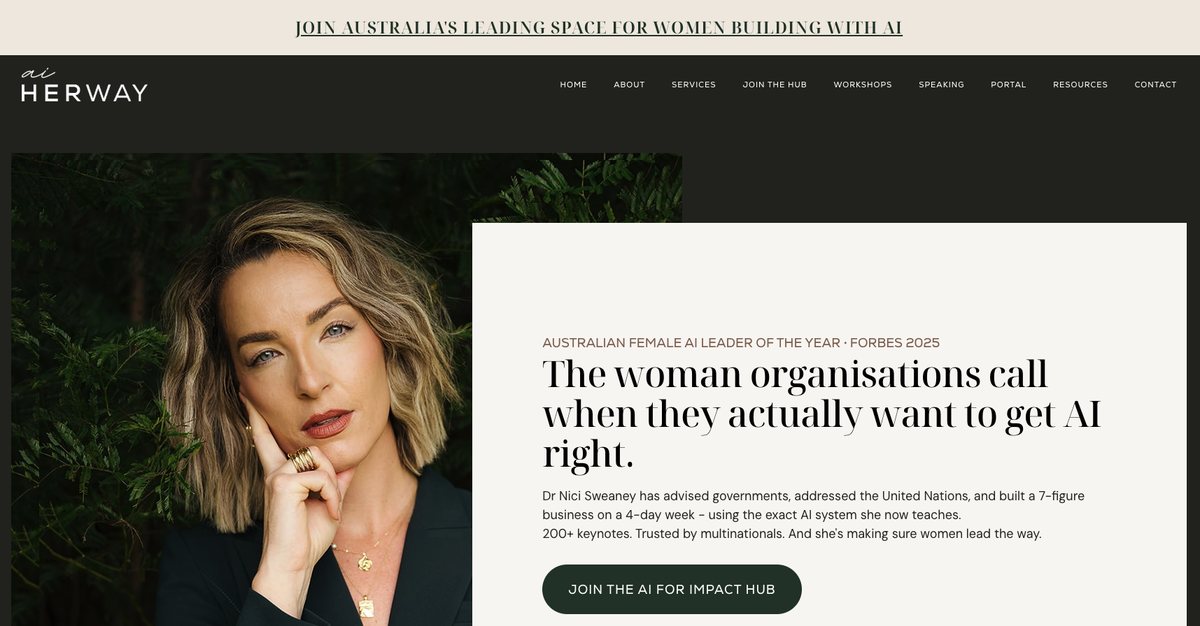
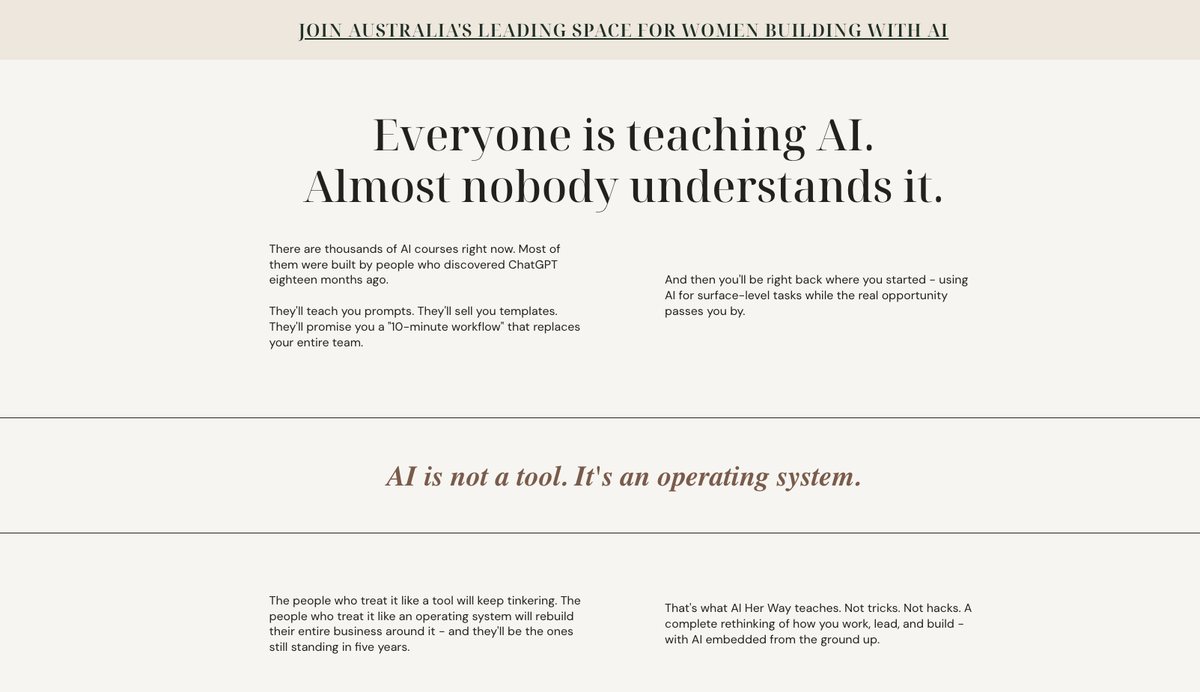
AI Her Way is led by Dr Nici Sweaney, named Australian Female AI Leader of the Year by Forbes in 2025. The public brand is direct, confident, and openly anti-hype, built on one frame: AI is not a tool, it is an operating system. Members arrive already fluent in that language and already sold on that idea.
That mattered more than it might sound. A coach that greets a new member in generic assistant voice breaks the promise before the session starts. So the brand voice was codified into a skills file and became layer 2 of the prompt architecture, sitting directly under the mission constraint. The rule that carried the most weight in practice: adjust pace, never tone. The audience is capable women under-served by hype culture, so the coach talks up to everyone and slows down only when it is asked to.
Five symptoms, one system problem
The member feedback the client shared reads like five separate problems:
- "It can feel like drinking from a firehose." A lot of value, but hard to know where to start.
- Navigation is not always intuitive. People are not sure what to do next.
- The content defaults to business use, which does not fit every member's goal.
- Some technical steps move too fast and quietly lose less confident members.
- The hardest gap is between learning something and actually implementing it.
I read it as one system problem with five symptoms. The Hub's default state is learning, and shipping is left to the member. Nothing in the journey defines what her first real result is, routes her to it, or marks the moment she gets it. Every symptom above is what that absence feels like from the inside.
That structure produces churn in a specific way. A member who ships something real in her first days has proof the Hub works for her life. She has a reason to come back, something to show, and an identity in the community. A member who only consumes has a slowly decaying intention. She does not complain. She drifts, exactly as the feedback describes.
Combine that with the 12-month renewal term and the lever becomes obvious. Does she ship a first win, fast? Results come first, and retention follows results.
The first win is a build,
not a lesson
The First Win Coach is a guided conversational session that takes a member from joining to one shipped, working artifact for her own work in about 30 minutes. It is not a lesson about AI. It is a build, with the coach doing the heavy lifting and the member supplying her reality.
The conversation has a fixed shape, so a free-form chat cannot wander:
Intake
Three questions, one at a time. What she does, what she would hand off to AI first, where she honestly is with AI. Ends with a reflection, so she feels seen before any work starts.
Scope the win
The coach names the build and frames it for her world: business, nonprofit, or professional. Never defaulting to business.
Build together
The coach walks the relevant lesson conversationally and drafts everything. She decides everything.
Test and ship
One real test, one round of refinement, then the artifact ships as a copyable card.
Close with momentum
Where to install it, what is next on her path, an invitation to post the win to the community.
It creates zero content burden, because it curates and applies lessons that already exist. And it quietly starts closing the deeper gap: in production, the intake answers and the shipped win write to platform custom fields, giving the Hub its first behavioral data about who its members are and where they stall.
Same method,
different altitude
The third intake question asks where she honestly is with AI, on four rungs. That single answer picks the altitude of the entire session. This is the part I care most about, because it is where most onboarding fails: a beginner flow bores an operator, and an operator flow loses a beginner. A 70-year-old just starting and a technical founder should both leave with something that runs.
A saved email assistant in her own voice
Fast, universal, and immediately useful. Capture her voice, extract a voice profile, assemble the assistant, install and test it.
- Ships as a reusable setup, not a paste-every-time prompt
- Designed against her real emails, not sample copy
- Working result inside one session
The smallest automated slice of a task she named
No paste-a-prompt session. The coach designs trigger, AI step, output, and human checkpoint for the real task from her intake, then writes the production prompt for it.
- Rung C ships a persistent agent plus an automation blueprint
- Rung D goes straight to architecture in her own tool (n8n, Make, Zapier)
- Scope discipline is the coach's job: advanced members reach for the cathedral, and the coach holds the line at one slice that runs today
Personalization here means better guidance, not more information. The intake exists to choose an altitude, not to collect data.
All of the intelligence lives in one prompt file
The product is deliberately thin: one chat page, one serverless function, one system prompt. No build step, no framework, no database. Claude Sonnet behind a Netlify function that holds the API key, with the whole experience governed by a single prompt file organized as seven layers. Each layer constrains the one below it, so the coach can improvise conversation without drifting from the mission.
What makes a free-form chat safe to put in front of paying members
A conversational product has no happy path you can enumerate, so the safety has to live in constraints rather than screens. Some of it belongs in the prompt, and some of it explicitly does not.
The browser never sees the API key
The page talks only to /api/chat. A Netlify function holds the key and forwards messages to Claude. Nothing sensitive is shipped to the client.
Rejected before any model call
Maximum 80 messages per conversation, 8,000 characters per message, first message must come from the user. Malformed requests never reach the model.
A token cap that doubles as a design rule
1,024 max output tokens per turn keeps the coach's messages short, which reinforces the coaching rules and caps spend at roughly US$0.30 to $0.50 per session.
The coach cannot invent the Hub
It knows two lessons and refuses to fabricate curriculum, URLs, members, or statistics. Real support issues escalate to the community instead of being guessed at.
Two things are load-bearing beyond the code. The coach drafts everything and the member decides everything, so judgment stays with her. And every automation the SYSTEM track designs has a human checkpoint written into it, framed as the Hub's ethics stance rather than a technical limitation.
One number the team can actually manage
Underneath the north star, three measures that each answer a question the team currently cannot answer:
- Time to first win. Whether 30 minutes is real or aspirational, measured rather than assumed.
- Drop-off by intake step, split by experience level. This turns "technical steps quietly lose less confident members" from an anecdote into a number, and it chooses what to fix next.
- 90-day engagement, shippers versus non-shippers. Do first-win shippers show higher lesson and community engagement? That validates the retention link long before renewal data can.
The intake answers and the shipped win are also the first behavioral data the Hub has ever held about individual members: use case, experience level, first-win status. That is the foundation everything after this depends on.
What I deliberately
did not do
Scope discipline was part of the deliverable, not a footnote to it. Eight hundred paying members are not a test environment.
Phase one of a compounding arc
The First Win Coach is not a feature. It is the first phase of a sequence where each phase ships standalone value and generates the data the next one needs. Nothing waits on a grand rebuild, and the existing member experience stays intact throughout.
First win
Guided first-win session plus a visible build log.
Applied coach
Every lesson ends in a real artifact, not a completed video.
Stall detection
Tiered, personal nudges. Human-reviewed before they are automated.
Adaptive roadmap
A living personalized path through the existing library.
Why this order. You cannot detect a stall without a definition of progress, and phase 1 creates one. You cannot coach across the curriculum without knowing where members hesitate, and phase 1's drop-off data chooses phase 2's lessons. You cannot re-engage credibly without activity signals, and phases 1 and 2 emit them. A personalized pathway is only worth building once intake, coaching, and re-engagement are proven parts. Phase 4 assembles them into one adaptive loop rather than betting the year on an unvalidated vision.
The roadmap is a hypothesis. Each gate is where evidence gets to revise it. Two principles hold at every gate: a phase must run without adding founder hours, and a phase must prove its number before the next begins.
A recommendation you can demo, not just read
The engagement asked for a one-page recommendation. I delivered the page and the working product together, because a strategy document about conversational onboarding is much easier to argue with than a session you can actually sit through. Anyone at the client company could become a member for three minutes and judge the idea on the experience rather than the pitch.
Underneath that, the pattern is the one I keep returning to. The five symptoms were not five problems. They were one missing structure, and the smallest real intervention that creates it is worth more than a roadmap that fixes all five in theory. Build the smallest thing that runs, instrument it, and let the evidence buy the next phase.
Play a member for three minutes at impacthubcoach.netlify.app ↗
The full prompt architecture and build notes are public at github.com/shannon-reframe/first-win-coach ↗